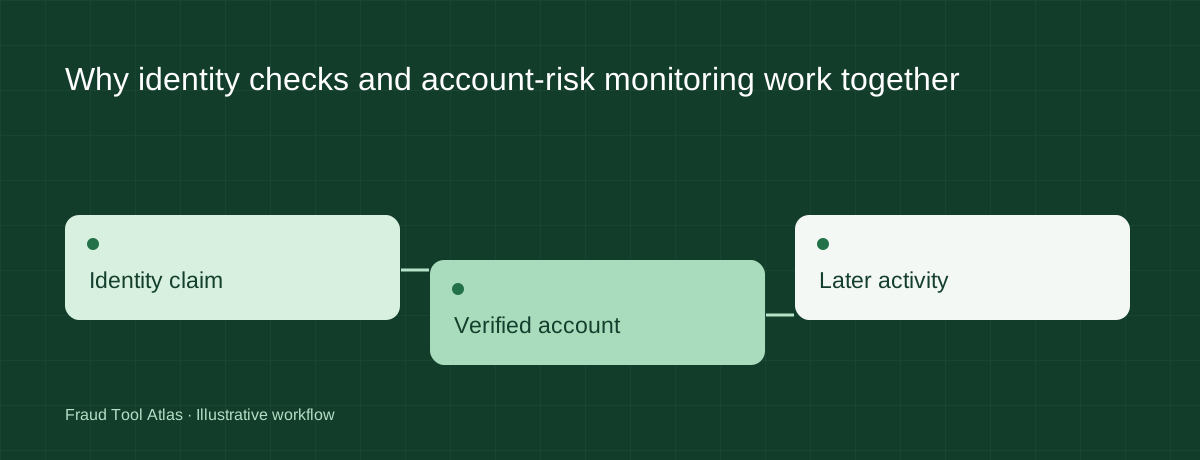
Identity verification and account-risk monitoring work at different points in a customer journey. Verification evaluates a claim through a defined process. Later observations help assess who is accessing the account and what they are doing. Connect the records while keeping their meaning and dates clear.
State the claim being verified
An identity document, a business record and an authentication factor support different claims. Begin with the service requirement and the population using the workflow. NIST’s Digital Identity Guidelines provide a vocabulary for separating proofing, authentication and federation; the required implementation depends on the service.
A vendor offering many identity and fraud modules does not establish that every module is included in one verification price. Confirm the purchased workflow, supported users, exception process and relevant data requirements.
Make completion part of the evaluation
Test the legitimate applicant’s path across supported documents, languages, devices and accessibility needs. Include a review or resubmission case. An automated response is only one part of the experience; the user must be able to understand and finish the process.
Record the relevant applicant reference, workflow version, result and time. If a later review changes the result, preserve the earlier record and the reason for the change, so support can explain whether the applicant completed a check or still needs help with an unresolved exception.
Keep the original record.
Continue the timeline after onboarding
An account can be accessed from a stolen session or changed recovery route after a genuine person completes verification. Observe relevant changes at login, password reset, recovery and sensitive actions. OWASP authentication guidance discusses reauthentication around risk events.
| Stage | Record | Practical question |
|---|---|---|
| Onboarding | Verification result and workflow | What claim was checked? |
| Login | Session and device observations | Is this an expected access pattern? |
| Recovery | Factors and ownership checks | Could a weaker route bypass protection? |
| Sensitive change | Action and authentication context | Should stronger verification apply? |
| Investigation | Evidence and outcome label | Can support reconstruct the decision? |
Use only the information appropriate for each task. A later risk signal should not silently overwrite the identity result, and an earlier verification should not suppress all later scrutiny.
Compare the commercial units carefully
Verification prices can include minimum commitments, successful-check definitions and optional modules. Device or transaction monitoring may have different units and packaging. Sumsub’s public pricing, for example, distinguishes Basic verification from the custom Fraud Prevention scope.
Model the complete journey: initial checks, resubmissions, step-ups and ongoing observations. Ask which events count as billable usage and which modules must be enabled before estimating the budget.
Review the combined workflow
For a pilot, follow one controlled account from verification into an ordinary login, a new device and a recovery attempt. Confirm that operators can retrieve the related records and explain a decision to the user. Keep incorrect restrictions and successful recovery in the evaluation.
The identity-verification category connects these questions to providers. Use account-abuse coverage to assess the controls that continue after onboarding.
Sources and further reading
Official product and technical sources reviewed October 21, 2026.
FAQ
Can an account be compromised after verification?
Yes. Verification establishes a result at a defined time. Later login, recovery and sensitive actions need their own appropriate controls.
What should link verification and device records?
Use the application’s stable account or applicant reference, event time and session identifier while preserving the meaning of each result.