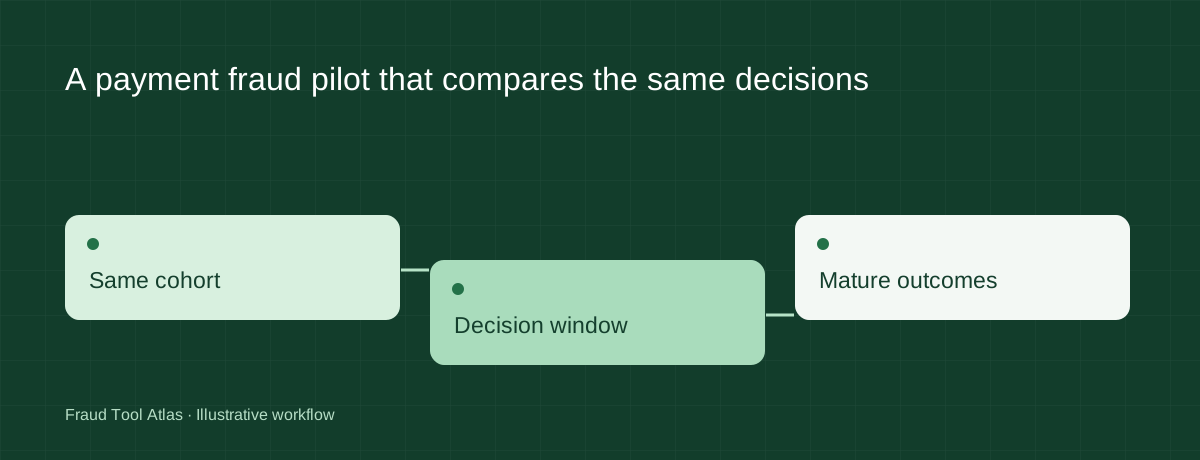
A fair payment-fraud pilot compares providers at the same point in the same payment journey. Define the cohort, the available evidence and the response deadline before measuring results. Otherwise, a fast response after authorization may be mistaken for a decision that prevented the payment from reaching that stage.
Draw the timeline first
Record session collection, order creation, authentication, fraud evaluation, bank authorization, settlement and fulfillment. Mark the last reversible step for the loss you want to prevent. A merchant shipping physical goods and a platform sending an instant payout face different deadlines.
For each step, note which system owns the action and what happens when a dependency fails. A timeout should have an explicit handling route, not silently become the same value as a low-risk response.
Keep the comparison cohort stable
Use an agreed set of eligible transactions and the same available data. Record exclusions, such as unsupported markets or products. If one provider receives additional device or history information, describe that difference rather than treating the outputs as an isolated model contest.
| Pilot record | What to retain |
|---|---|
| Transaction reference | One stable ID across systems |
| Decision point | Before or after authorization |
| Collection status | Complete, incomplete or failed |
| Output and reason | The original provider response |
| Action | Approve, review, hold or decline |
| Outcome window | When the label is considered mature |
This record also helps diagnose implementation problems. An apparently weak result may be a missing event or an association error rather than the intended production behavior.
Separate a response from an outcome
A score is not a confirmed loss label. A reviewed order is not automatically fraudulent. A transaction with no dispute yet is not automatically genuine. Maintain labels that reflect what the team actually knows and when it learned it.
Disputes and other loss signals can arrive later. Compare mature cohorts where practical, and show unresolved cases separately. The dispute lifecycle documentation provides useful context for why an immediate dashboard view is incomplete.
Review several outcomes together
Use accepted legitimate transactions, confirmed fraud losses, review time, customer friction and payment costs. Explain the denominator for each rate. A lower fraud count after declining more orders does not tell you whether the business outcome improved.
For a guarantee product, include eligibility and reimbursement work as a separate part of the evaluation. For a decisioning platform, include the effort to maintain rules and return outcome labels. The purchased operating model matters.
End with a decision your team can support
Write down which uncertainty the pilot resolved, which integration gaps remain and which customer segments require more testing. Agree on the rollout owner, monitoring window and reversal plan for policy changes.
Use the payment category to narrow the provider set and the comparison framework to keep scope, timing and commercial units consistent.
Sources and further reading
Official product and technical sources reviewed October 21, 2026.
FAQ
Can a one-day trial prove a chargeback reduction?
It can reveal integration and operational behavior. Loss outcomes may mature later, so define the observation window and unresolved cases.
Should the pilot optimize only for fewer declines?
No. Compare accepted legitimate business, confirmed fraud losses, review work, friction and costs on the same cohort.