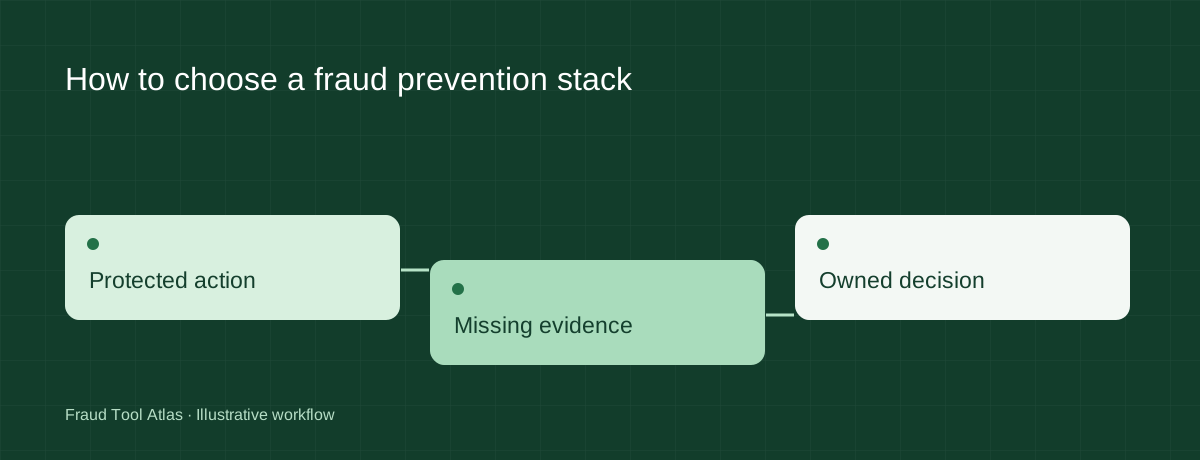
A useful fraud stack starts with a decision you need to make. Name the action, the evidence available before it happens and the person who owns the response. That map makes it easier to compare products that otherwise use similar language for very different jobs.
Start with one protected action
“Reduce fraud” is too broad for an integration plan. “Review a newly changed payout destination before releasing funds” has a deadline, an owner and an outcome. Other starting points include claiming a referral reward, accessing an existing account or approving an ecommerce order.
Write down what would happen without the new tool. Support might already review the action; the payment processor might provide a score while the application cannot recognize the returning device behind it.
The existing workflow tells you which layer is missing.
Put the evidence into separate boxes
Device recognition connects observations from an environment. Network context describes the connection. Identity verification checks a claim about a person or business. Transaction risk evaluates a payment, while bot protection addresses automation. An account history links these observations to what the user actually did.
| Buyer question | Evidence to inspect | Integration question |
|---|---|---|
| Have we seen this environment? | Device or visitor record | How is it linked to the user? |
| Is the connection masked? | Named network signals | When was the check collected? |
| Does the identity claim pass? | Verification outcome | Which workflow and population? |
| Should this order proceed? | Payment and order context | Before which irreversible step? |
| Is this automated abuse? | Request and client behavior | Where is enforcement applied? |
The same vendor can supply several boxes. Confirm which product and integration actually does so. A feature listed somewhere in a portfolio is not automatically part of your proposal.
Decide who operates the response
An API response does not remove operational work. Someone must maintain thresholds, investigate exceptions and handle legitimate customers affected by a decision. Ask how support can retrieve the original evidence and how a wrong restriction is reversed.
For a small team, the cost of operating several components may matter as much as subscription fees. For a mature risk team, fine control and access to raw events can be more valuable than a ready-made policy. Compare the work your team can sustain.
Request a proposal with usable units
Ask for the number of identifications, verifications, transactions or requests you expect at the protected action. Add peak volume, retry behavior and the plan features you need. Keep annual commitments and minimum spend visible.
A price per browser check cannot be ranked directly against a percentage of guaranteed order value. Calculate each option against the same business journey, including engineering, review and loss exposure.
Use the first pilot to resolve one uncertainty
Choose a controlled scenario that could change the buying decision. Can the tool connect a repeat account claim? Does its response arrive before authorization? Can a genuine customer recover from an incorrect challenge? Agree on the record that will demonstrate the answer.
Start with the category atlas, compare the tool roles, and use the methodology to write a short evaluation plan. Expand the stack when another clearly defined gap remains.
Sources and further reading
Official product and technical sources reviewed October 21, 2026.
FAQ
Should a small team buy a complete platform first?
Start with the protected action and the evidence missing from the current workflow. A combined platform can reduce integration work, while a component can fit an existing risk system.
What should the first proposal contain?
List collection requirements, outputs, decision timing, operator duties, volume units and the proposed product scope.