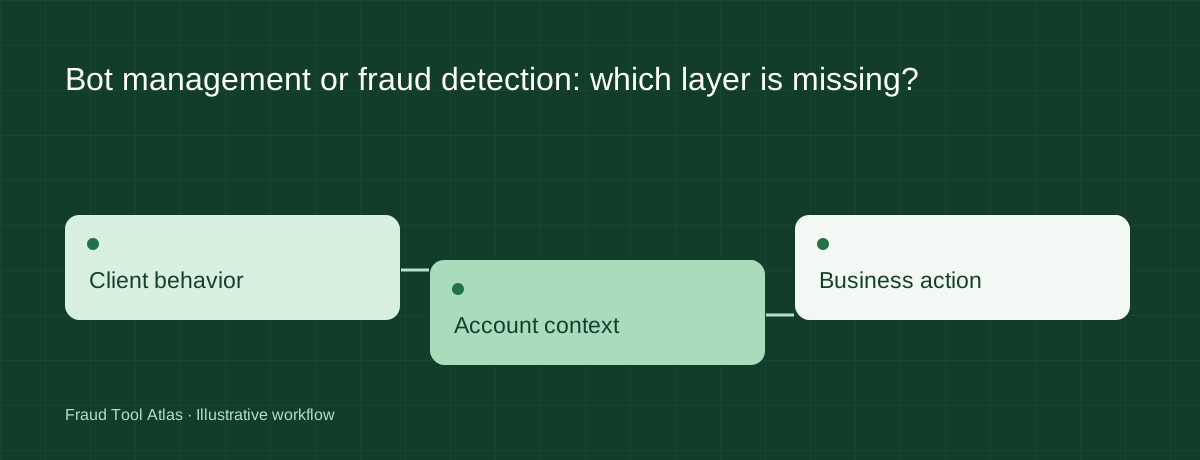
Bot management helps distinguish and control automated activity. Fraud detection can also assess account relationships, payment intent, identity claims and later outcomes. To choose the missing layer, describe the abusive action and the evidence your existing controls cannot provide.
Begin with the action, not the label
Credential stuffing involves repeated attempts to use credentials. Inventory scraping can consume infrastructure or expose commercially valuable data. A referral program can be exploited through many accounts, including accounts operated manually. Each scenario needs a different view of the activity.
OWASP’s automated-threats project organizes threats by their business behavior. Use that approach to name the process being abused, rather than treating “bot” as a complete incident description.
Separate classification and policy
A request may come from authorized automation. Search indexing, uptime monitoring, accessibility tools and partner integrations can be legitimate clients. Decide which actions each client may take and how your system verifies permission before applying the same enforcement to a public crawler and a customer login.
Permission is part of the policy.
| Layer | Useful evidence | Remaining question |
|---|---|---|
| Request and client | Automation and environment signals | Is this client authorized here? |
| Account | Login history and linked activity | Does the action fit the account? |
| Identity | Verification and ownership checks | Is the claim sufficiently supported? |
| Payment | Transaction and order context | Should value move now? |
| Outcome | Confirmed abuse and appeals | Did the control help the customer journey? |
The table is a map of responsibilities. One provider may cover several layers, while another may fit as a focused component in an existing system.
Evaluate the enforcement experience
When a provider uses a challenge, inspect the entire route from collection to server verification. Record how the server binds the result to the session or action and what happens when collection fails. Test mobile clients and accessibility needs alongside a normal desktop browser.
A successful challenge is one observation. It does not establish that an account owns a payment method or is entitled to redeem a reward. Keep downstream account rules explicit.
Measure the cost of friction
Count challenge presentations, completions, extra latency, support contacts and restored access. Review results by endpoint and client type. A control that blocks a large number of requests can still interrupt a small but valuable group of legitimate users.
Where the architecture allows it, begin by observing and inspecting the classifications before enforcing them broadly. Assign an owner and a rollback route to each policy so the team can change its response while preserving the original evidence.
Build a shortlist around the gap
DataDome and Arkose Labs offer bot and enforcement workflows. Device-centered products can add recognition and environment evidence to an application’s own policies. Broader account-risk products connect that evidence to misuse over time.
Read the bot-protection category and the alternatives guide to compare these roles. The question is which product supplies the missing capability in your specific workflow.
Sources and further reading
Official product and technical sources reviewed October 21, 2026.
FAQ
Can a human-operated account still be abusive?
Yes. Automation is one dimension. Policy abuse, stolen accounts and payment misuse can also involve human actions.
Can a challenge replace account authentication?
A challenge result and proof of account ownership answer different questions. Bind each control to the action it is intended to protect.